What Happens When We Tokenize Everything?
Imagine collapsing all financial and real-world silos into a single, programmable engine of liquid value. Imagine the next paradigm shift, not just dollar-backed tokens.
The broader payments industry remains hyper-focused on basic fiat stablecoins like USDC and USDT. But dollar-backed stablecoins are merely the first working prototype of a much larger blueprint.
Let’s take a step back: what does tokenization in the world of payments mean? At its core, tokenization means representing real-world value — from fiat dollars, such as USD, EUR, BRL, airline miles, like One Star, LATAM Miles, reward programs, such as Starbucks Rewards or cloud credits, from Claude to ChatGPT — as digital, programmable assets on a blockchain. For both users and companies, this transforms locked, static balances into liquid, borderless value that can be spent, swapped, or moved instantly, anywhere, with minimal friction.
Let’s go back to our main idea: the next massive paradigm shift is the universal tokenization — not just the basic movement from fiat onto blockchains; it’s collapsing traditional silos so that any representable asset can be treated as liquid, programmable value.
In engineering and finance, solving a complex equation starts with defining its core variables. If we frame the global movement of value as a math problem, it breaks down into three simple components:
{Problem (Unconnected Value)} + {Rationale (Interoperability)} = {Solution (Universal Liquidity)}
Let’s start with the left side of the equation.
The Problem: Value Trapped in Unconnected Drawers
For a modern corporate treasurer, CFO, or everyday consumer, wealth rarely sits in just one place. Instead, it is scattered across dozens of separate, unconnected drawers — each locked in its own system, completely isolated from the rest. Let’s use some real-life examples:
- Loyalty Programs: Millions of dollars in airline miles, hotel points, and store rewards sit unused in digital accounts, slowly losing value to expiration policies.
- Cloud & Infrastructure Credits: Tech companies sit on tens of thousands in underutilized AWS or Claude AI compute credits while managing tight cash flow elsewhere.
- Yield-Bearing Treasury Holdings: A corporate team holds short-term T-bills or yield-bearing money market funds that earn interest, but can’t be used to settle an urgent Friday afternoon supplier invoice without a two-day liquidation delay.
- The Digital Asset Drawer: Traditional real-world assets like commercial real estate, tokenized private equity, or specialized commodities remain locked away from daily payment flows.
Today, moving value between any of these individual drawers requires a slow, expensive network of intermediaries, high friction, or outright restrictive rules. You can’t naturally buy a coffee in Berlin using your excess Seattle compute credits, nor can you easily route your airline miles directly into local fiat to pay a contractor in São Paulo.
The total value exists, but because each drawer remains locked and disconnected, your instant liquidity is effectively zero until you move everything back through traditional cash.
The Vision: Everything as an Asset Pair
When assets are tokenized on open rails and backed by programmatic translation layers, the distinction between an "asset" and "spendable money" disappears.
Imagine a world where:
- A developer in Seattle instantly swaps idle Claude AI compute credits or Starbucks rewards to pay a local merchant in Berlin, settled natively in Euros via local instant payment rails like SEPA.
- A remote worker on-ramps OneWorld airline miles directly into USD-C, which then instantly settles into Mexican Pesos over SPEI.
- A treasury manager holds yield-bearing tokenized T-bills that automatically break down and settle micro-payouts in real-time Brazilian Pix transactions without human intervention.
In this paradigm, liquidity isn't defined by what is in your bank account — it’s defined by the total net worth of your digital ledger.
Why Infrastructure is the Bottleneck
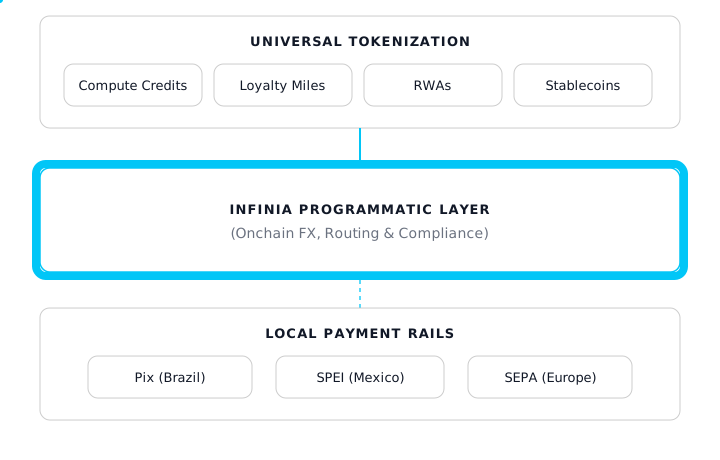
Making this a reality requires solving a complex engineering and regulatory challenge: the conversion layer.
Tokenizing an asset on-chain is only half the battle. To complete the transaction, that tokenized asset must dynamically route through on-chain FX markets and off-ramp natively into local banking grids: instantly, programmatically, and within strict compliance boundaries.
This is where the future of global payments will be won. It won't just be about moving crypto from Wallet A to Wallet B. It will be about building the invisible engine that accepts any digital asset on one end and delivers exact local fiat on the other.
At Infinia, we built our unified API to bridge local instant payment rails with digital asset infrastructure. As the universe of tokenized assets expands from USD stablecoins to loyalty points, compute, and RWAs, our goal remains the same: ensuring value moves anywhere instantly, frictionlessly, and programmatically.